
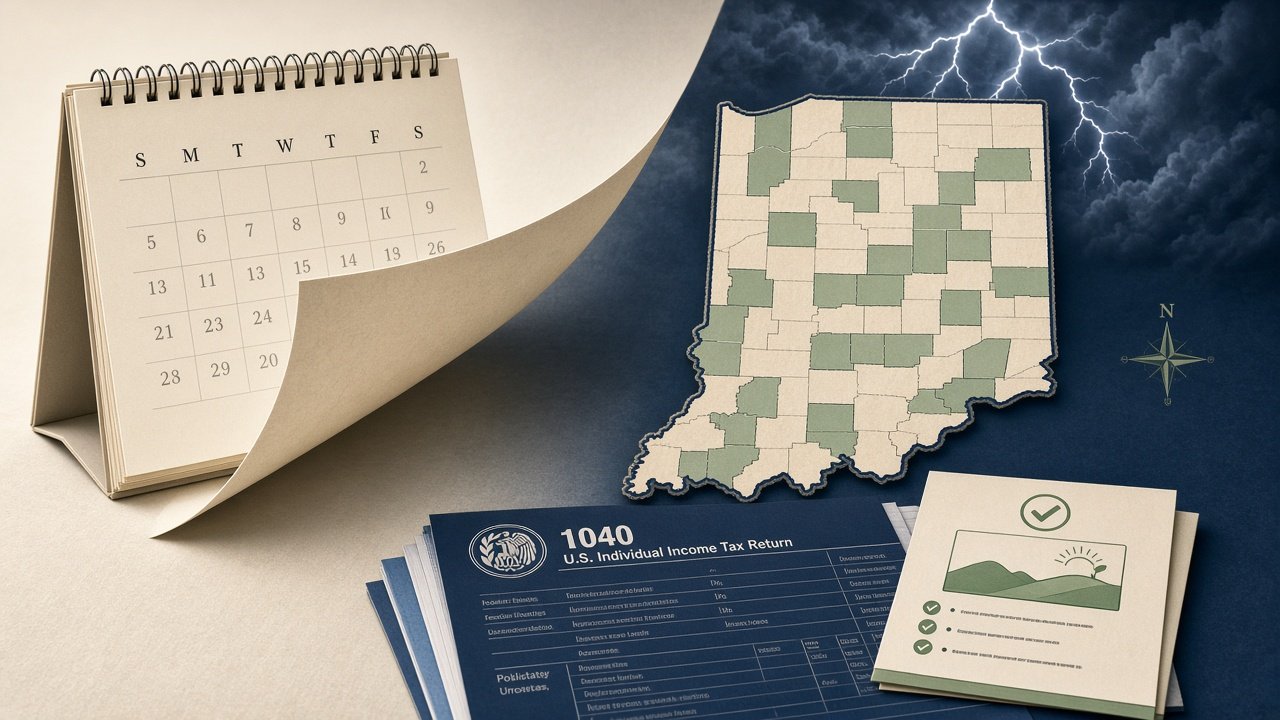
- Taxpayers in 21 specified Indiana counties have until Feb. 1, 2027, to file most returns and pay taxes originally due between Aug. 11, 2026, and that date.
- Estimated tax payments and certain quarterly payroll or excise returns receive relief, but 2025 income tax payments due April 15, 2026, and most information returns do not.
- Affected taxpayers should place FEMA number 4933-DR on returns claiming casualty losses and contact the IRS at 866-562-5227 if they live outside the covered area but were impacted.
For background on this issue, read our Disaster tax deadlines guide and check the disaster deadline tracker.
Who Qualifies for Indiana Disaster Tax Relief
The IRS announced this relief on September 2, 2026, following a FEMA disaster declaration for severe storms, straight-line winds, tornadoes, and flooding that began on August 11, 2026. The covered disaster area includes Carroll, Dearborn, Decatur, Delaware, Fayette, Franklin, Hamilton, Hancock, Henry, Lake, LaPorte, Madison, Marion, Morgan, Porter, Pulaski, Randolph, Rush, Tipton, Union, and Wayne Counties in Indiana.
Affected taxpayers are those who live in these counties, operate a business there, or have records necessary to meet a tax deadline stored in the area. Relief also extends to recognized relief workers assisting in the covered area and individuals visiting who were killed or injured by the disaster.
The IRS automatically applies the relief to taxpayers it identifies in the covered area. Those outside the listed counties but impacted should call the IRS Special Services toll-free line at 866-562-5227 to request it. Tax practitioners with records for ten or more clients outside the area should review IRS bulk request guidance.
Key Deadlines Now Extended to February 1, 2027
Most federal tax returns and payments with original or extended due dates falling on or after August 11, 2026, and before February 1, 2027, receive an automatic extension to February 1, 2027. This includes individual, corporate, estate, trust, partnership, S corporation, and exempt organization returns, as well as employment and certain excise tax returns.
Estimated income tax payments originally due on or after August 11, 2026, are postponed until February 1, 2027, without failure-to-pay-estimated-tax penalties if paid by then. Quarterly payroll and certain excise tax returns normally due November 2, 2026, also move to the new deadline.
The extension covers other time-sensitive acts listed in IRS regulations and procedures that fall within the postponement window. Under recent legislation, the postponed return deadline counts as an extension when calculating refund claim limits, providing extra time for refunds or credits.
Important Exceptions and Limitations
Tax payments for 2025 individual income tax returns, which were due April 15, 2026, even if the return itself was on extension, do not qualify for this relief. Penalties on payroll and excise tax deposits due between August 11 and August 26, 2026, are waived only if deposits are made by August 26, 2026.
The postponement generally does not apply to information returns in the W-2, 1094-1099 series, Forms 1042-S, 3921, 3922, 8027, or most employment and excise tax deposits. Late-filing or late-payment penalty notices for dates within the postponement period can be abated by calling the number on the notice.
Installment agreements remain in effect without defaulting for missed payments during the period, though interest and late-payment penalties continue to accrue. Taxpayers wanting to suspend direct debits should contact the IRS or their bank.
How to Claim Casualty Losses and Other Benefits
Affected taxpayers may deduct disaster-related casualty losses on either the 2026 return or the prior year’s return. They have up to six months after the return’s due date (without extensions) to make this election. Place FEMA disaster declaration number 4933-DR at the top of the return. See IRS Publication 547, Form 4684, and its instructions for details on uninsured personal property losses.
Qualified disaster relief payments from government agencies for living expenses, home repairs, or replacement of contents are generally excluded from gross income. The IRS also waives fees for copies of previously filed returns if FEMA number 4933-DR is written in bold at the top of Form 4506 or 4506-T.
Additional options may include special retirement plan distributions not subject to the 10% early withdrawal tax, spread over three years, or hardship withdrawals. Review Form 8915-F and related guidance. The government may further extend FBAR deadlines; check specific notices.
Next Steps for Affected Taxpayers
First, confirm whether your residence, business location, or records fall within one of the 21 listed Indiana counties or otherwise meet the affected taxpayer definition under IRS rules.
Determine which of your tax returns, estimated payments, or other acts have due dates on or after August 11, 2026, and before February 1, 2027, to identify what is postponed.
If claiming a casualty loss, include FEMA number 4933-DR on the appropriate year’s return and gather supporting documentation on uninsured losses using Form 4684. For penalty notices received, call the number provided to request abatement.
If you live or operate outside the covered counties but were affected, or if you are a tax practitioner needing bulk relief, contact the IRS Special Services at 866-562-5227. Download forms and publications directly from IRS.gov and monitor for any future additional relief.
Republic Tax Relief can discuss your existing tax-debt questions that fall outside this disaster relief program during a free, no-obligation initial consultation; readers should ask about suitability, scope, fees, and availability of private tax-resolution services for IRS or state issues.
Free Tax Preparation Resources
Eligible individuals and families can receive free return preparation help at Volunteer Income Tax Assistance (VITA) or Tax Counseling for the Elderly (TCE) sites by using the VITA Locator Tool or calling 800-906-9887. Note that VITA sites typically cannot assist with disaster loss claims.
AARP Tax-Aide sites are available via their locator tool or by calling 888-227-7669. Taxpayers with 2025 adjusted gross income of $89,000 or less can use IRS Free File Guided Tax Software or Free File Fillable Forms. Military members and some veterans may use MilTax for free federal and up to three state returns.
Announcement covered: Sep 2, 2026.
General information only, not individual tax, legal, or financial advice. Rules, deadlines, and eligibility depend on your circumstances. Check current official guidance or consult a qualified professional.
Request a correction →