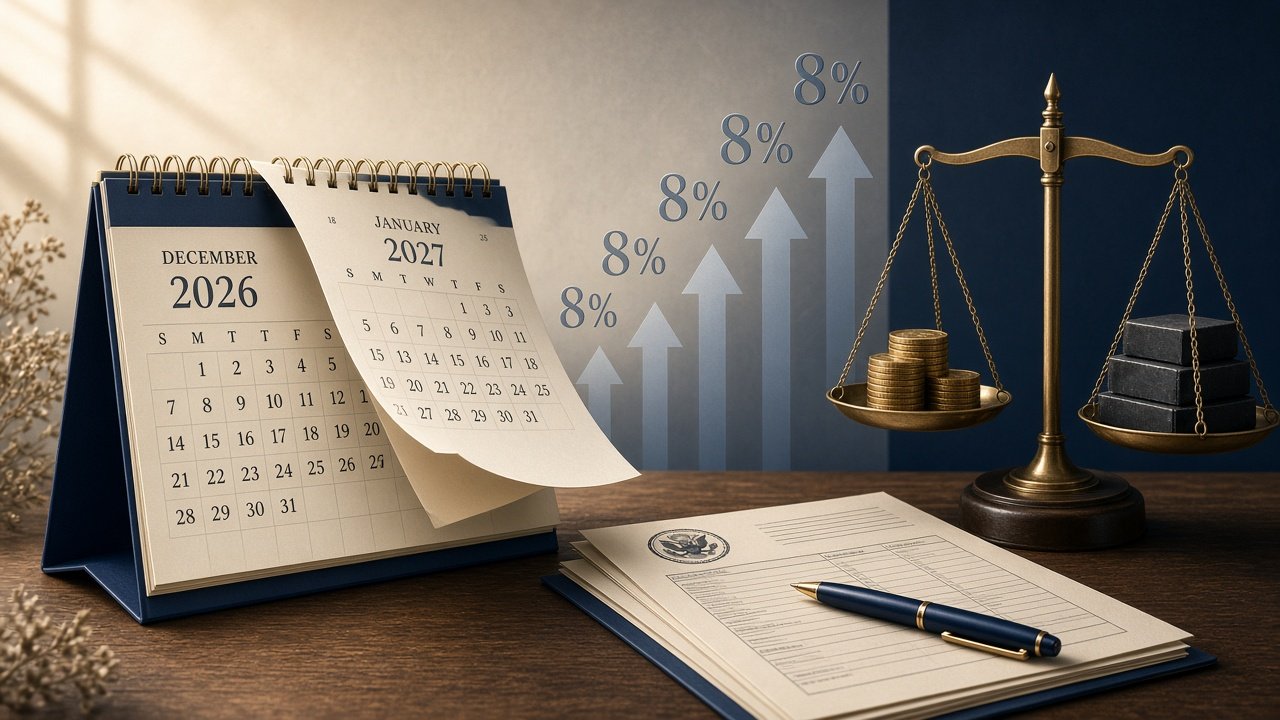
- Individual taxpayers will face an 8% rate on both overpayments and underpayments, compounded daily, for the quarter beginning January 1, 2027.
- Corporate rates differ: 7% on overpayments, 5.5% on the portion over $10,000, 8% on underpayments, and 10% on large corporate underpayments.
- Rates are set quarterly based on the federal short-term rate from October 2026 plus fixed percentages under the Internal Revenue Code.
What the IRS Announced on November 24, 2026
The Internal Revenue Service released IR-2026-144 announcing that interest rates will increase for the calendar quarter beginning January 1, 2027. For individuals, both the overpayment rate (refund interest the IRS pays) and underpayment rate (interest charged on unpaid taxes) will be 8 percent per year, compounded daily.
Corporate rates remain differentiated. The overpayment rate for corporations is 7 percent, while the rate on the portion of a corporate overpayment exceeding $10,000 drops to 5.5 percent. Underpayment rates are 8 percent generally and 10 percent for large corporate underpayments.
These rates are computed from the federal short-term rate determined during October 2026. Details appear in Revenue Ruling 2026-25, which will be published in the Internal Revenue Bulletin 2026-51 on December 14, 2026.
Myth: The Rate Increase Only Applies to Taxes Owed
A common misconception is that rising IRS interest rates affect only taxpayers who owe money. In reality, the same 8 percent rate applies to both underpayments and overpayments for non-corporate taxpayers beginning in the first quarter of 2027.
This means individuals who overpay their taxes and are owed a refund will see the IRS pay interest at the higher 8 percent rate. The announcement treats the overpayment and underpayment rates identically for individuals, directly countering the idea that higher rates only penalize those with balances due.
The IRS determines rates quarterly under the Internal Revenue Code. For taxpayers other than corporations, both rates equal the federal short-term rate plus 3 percentage points.
Myth: Higher Rates Mean the IRS Is Changing Collection Rules
Another frequent misunderstanding is that an interest-rate increase signals broader changes to IRS collection practices, enforcement priorities, or penalty structures. The announcement addresses only the quarterly interest rates and does not alter any other tax administration rules.
Interest continues to be compounded daily. Corporate rates follow different formulas: underpayments use the short-term rate plus 3 points, overpayments use plus 2 points, large corporate underpayments add 5 points, and the portion of corporate overpayments above $10,000 uses plus 0.5 point.
Taxpayers should review their specific situations against the revenue ruling rather than assume the rate change affects deadlines, payment plans, or penalty relief.
Practical Implications and What to Verify
The increase affects interest calculations on any overpayments or underpayments that accrue during the January-March 2027 quarter. It does not apply retroactively to earlier periods. Readers with existing balances or expected refunds should confirm how the new rates interact with their filing and payment dates.
The source provides no information on extensions, abatements, or relief programs. Questions about how these rates apply to a specific tax year, installment agreement, or refund timing should be checked directly with the IRS or a qualified tax professional.
Republic Tax Relief offers private tax-resolution services for individuals and businesses facing IRS or state tax issues. Taxpayers with existing tax-debt questions separate from this quarterly rate adjustment can contact the firm for a free, no-obligation initial consultation to evaluate suitability, scope, fees and availability of help communicating with the IRS.
Announcement covered: Nov 24, 2026.
General information only, not individual tax, legal, or financial advice. Rules, deadlines, and eligibility depend on your circumstances. Check current official guidance or consult a qualified professional.
Request a correction →