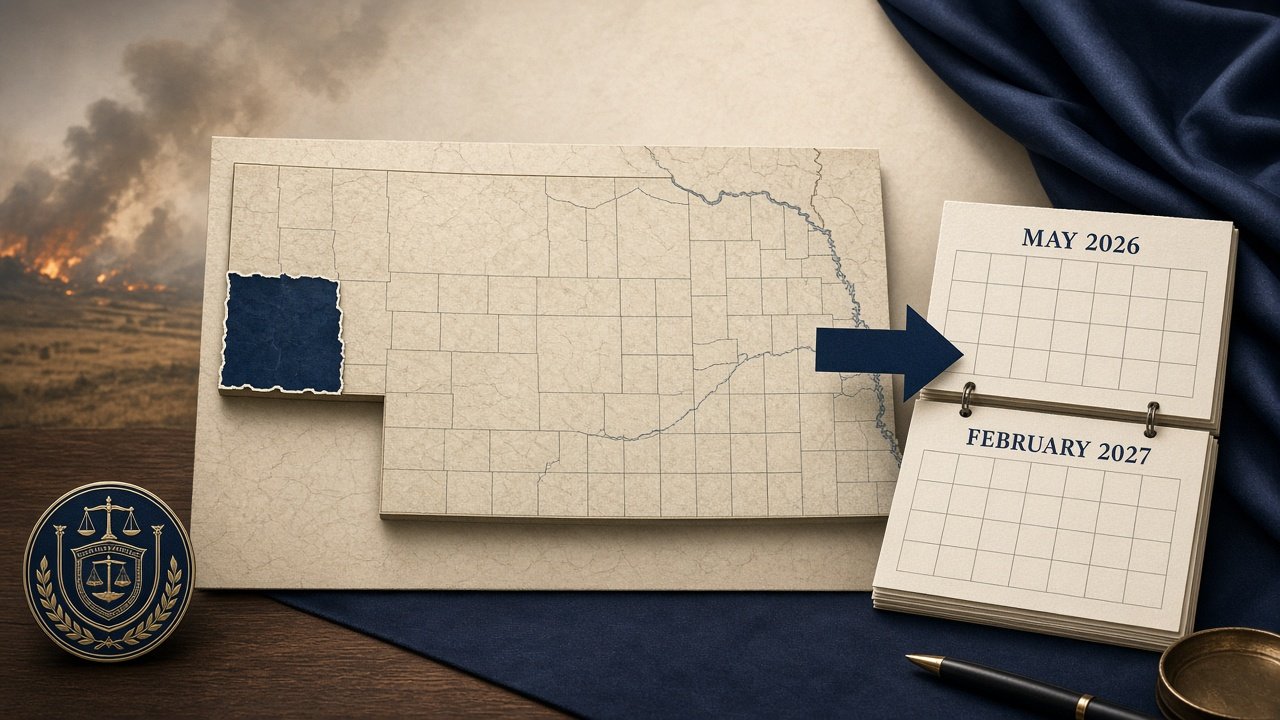

- Only Custer County residents and businesses, plus certain record holders, relief workers, and injured visitors qualify for the Feb. 1, 2027 postponement under NE-2026-04.
- Estimated tax payments and most returns originally due after April 22, 2026, receive relief, but 2025 income tax payments due April 15, 2026, and many information returns do not.
- Affected taxpayers should write SD-0011-DR on Form 4506 or 4506-T for waived copy fees and contact the IRS about any penalty notices received.
For background on this issue, read our Disaster tax deadlines guide and check the disaster deadline tracker.
Announcement and Affected Area
On August 25, 2026, the Internal Revenue Service announced tax relief for taxpayers impacted by the Pressey Fire that began April 22, 2026, in central Nebraska. The relief follows a state disaster declaration for Custer County.
The IRS designates Custer County as the covered disaster area under Treas. Reg. §301.7508A-1(d)(2). This announcement applies specifically to that locality and does not extend statewide.
The evidence desk notes that the source announcement date of August 25, 2026, precedes today's date by more than a month; readers should treat this as established relief rather than new breaking guidance.
Who Qualifies for Relief
Affected taxpayers include individuals who live in Custer County and businesses, including tax-exempt organizations, whose principal place of business is located there. Taxpayers outside the county whose necessary records are in the covered area also qualify.
In addition, relief workers affiliated with recognized government or philanthropic organizations assisting in the area, and any individual visiting who was killed or injured by the disaster, are entitled to relief under section 7508A.
Republic Tax Relief notes that taxpayers facing separate existing IRS or state tax debt issues unrelated to this wildfire relief may have distinct questions about communication with the IRS; the firm offers a free, no-obligation initial consultation to evaluate suitability, scope, fees and availability of private tax-resolution services for such matters.
Extended Deadlines and Key Exceptions
The IRS postpones until Feb. 1, 2027, the time to file most tax returns—including individual, corporate, estate, trust, partnership, S corporation, employment and certain excise tax returns—whose original or extended due dates fall on or after April 22, 2026, and before Feb. 1, 2027.
Estimated income tax payments originally due on or after April 22, 2026, are also postponed to Feb. 1, 2027, without failure-to-pay-estimated-tax penalties if paid by that date. The same deadline applies to other time-sensitive acts listed in Treas. Reg. § 301.7508A-1(c) and Rev. Proc. 2018-58.
Important exceptions remain. Tax payments for 2025 individual income tax returns, even those with a valid extension, were due April 15, 2026, and are not covered. Payroll and excise tax deposits due between April 22 and May 6, 2026, receive penalty abatement only if deposited by May 7, 2026. Many information returns in the W-2, 1099 and similar series are not postponed.
Penalty Notices, Additional Relief and Next Steps
If an affected taxpayer receives an IRS late-filing or late-payment penalty notice with an original due date inside the postponement window, the taxpayer should call the number on the notice to request abatement.
Under the Disaster Related Extension of Deadlines Act, the postponement counts as an extension when calculating refund claim limits. The IRS also waives fees for copies of previously filed returns when Form 4506 or 4506-T is submitted with SD-0011-DR written in bold at the top.
Qualified disaster relief payments for personal, living, funeral, repair or replacement expenses are generally excluded from gross income. Additional retirement-plan and IRA relief, such as special disaster distributions or hardship withdrawals, may be available under separate rules detailed in Form 8915-F and related guidance. The IRS may provide further relief later.
Verification and Reasonable Cause Considerations
Taxpayers should verify their specific situation against IRS Publication 525, disaster relief FAQs on retirement plans, and any future updates at IRS.gov. Those not qualifying for this disaster relief may still seek reasonable-cause penalty abatement.
Affected taxpayers contacted by the IRS on collection or examination matters should explain the disaster’s impact. Free tax-preparation assistance remains available through VITA, TCE, AARP Tax-Aide, IRS Free File and MilTax programs, though VITA sites generally cannot assist with disaster-loss claims.
Announcement covered: Aug 25, 2026.
General information only, not individual tax, legal, or financial advice. Rules, deadlines, and eligibility depend on your circumstances. Check current official guidance or consult a qualified professional.
Request a correction →