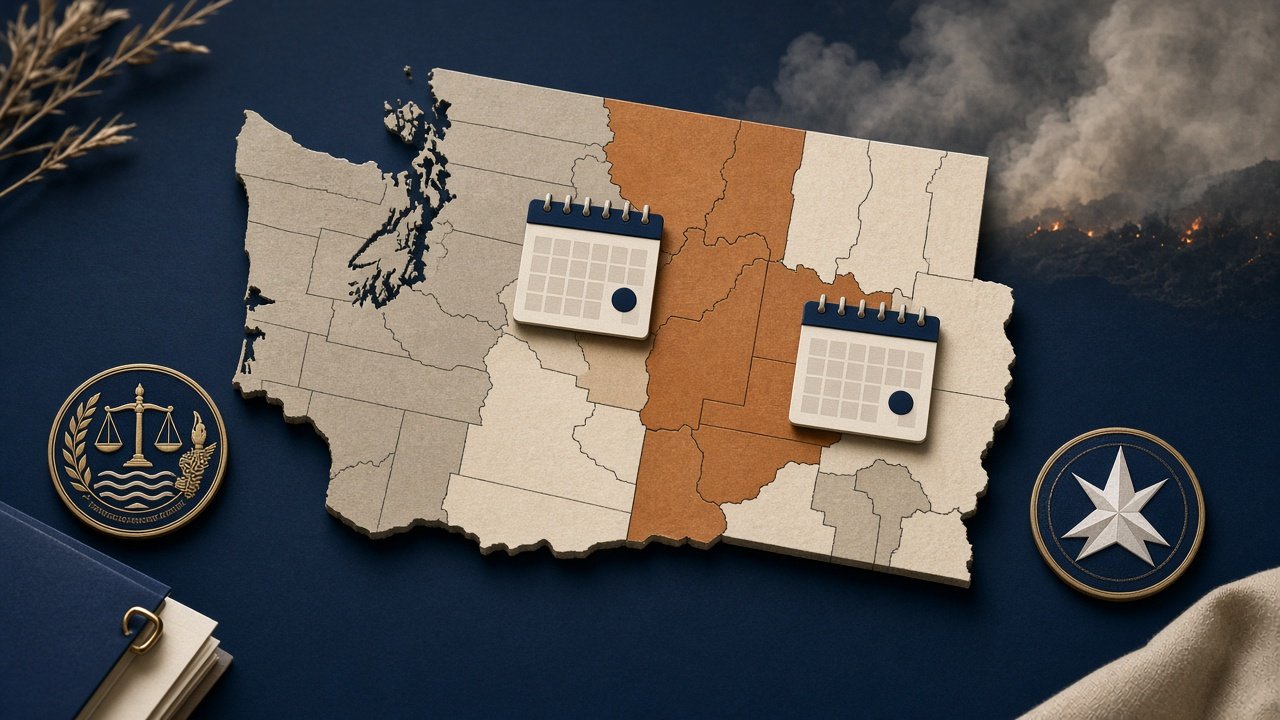

- Only individuals, households, and businesses located in Douglas County qualify; relief also extends to certain record-keepers, relief workers, and those injured in the area.
- Estimated tax payments and most returns due between July 31, 2026 and Feb. 1, 2027 get extra time, but 2025 return payments originally due April 15, 2026 do not qualify.
- Interest and penalties continue to accrue on missed payments during the extension; installment agreements stay active but direct debits must be managed separately.
For background on this issue, read our Disaster tax deadlines guide and check the disaster deadline tracker.
Who Qualifies for the Douglas County Wildfire Relief
The IRS announced this relief on August 31, 2026 following a state disaster declaration for wildfires that began July 31, 2026. Relief applies to affected taxpayers in the covered disaster area of Douglas County, Washington.
This includes individuals who live there, businesses and tax-exempt organizations whose principal place of business is in the county, and those whose necessary records are located in the area. Relief workers affiliated with recognized government or philanthropic organizations assisting in the area, plus anyone visiting who was killed or injured, also qualify.
A common misunderstanding is that all Washington residents automatically receive this relief. Only those tied to Douglas County meet the criteria under the IRS rules.
Filing and Payment Deadlines Now Due by February 1, 2027
Most federal tax returns and payments with original or extended due dates falling on or after July 31, 2026 and before February 1, 2027 are now due by February 1, 2027. This covers individual, corporate, estate, trust, partnership, S corporation returns, employment and certain excise tax returns, plus estimated income tax payments.
Other time-sensitive acts listed in IRS regulations also receive the extension. However, the postponement does not cover information returns in the W-2, 1099 series or similar forms unless specifically listed elsewhere.
Consumers should be aware that this extension applies to filing and estimated payments but does not stop interest and late-payment penalties from accruing if balances remain unpaid until the new deadline.
Important Exceptions and Consumer Protections
Taxes related to 2025 individual income tax returns that had a valid extension to file are covered for the return itself, but the payments originally due on April 15, 2026 are not eligible for this relief. Payroll and excise tax deposits due between July 31 and August 17, 2026 avoid penalties only if made by August 17, 2026.
For those in installment agreements, reminder notices and direct debits continue, but missed payments during the postponement period will not trigger a default. Taxpayers wanting to pause direct debits should contact the IRS or their bank. The IRS will also waive usual fees for copies of previously filed returns if the disaster declaration number SD-0015-DR is noted on Form 4506 or 4506-T.
Qualified disaster relief payments from government agencies for living expenses, home repairs, or funeral costs can generally be excluded from gross income. Additional options may exist for retirement plan distributions or FBAR filings, though each has specific rules.
Handling Penalty Notices and Next Steps
If you receive an IRS late-filing or late-payment penalty notice with an original due date in the postponement window, call the number on the notice so the penalty can be abated. The Disaster Related Extension of Deadlines Act also provides extra time to claim refunds or credits.
Affected taxpayers contacted about collection or examination matters should explain the disaster's impact. Those not qualifying for this specific relief may still seek reasonable cause penalty abatement.
Republic Tax Relief notes that while this announcement addresses disaster-related filing extensions rather than existing tax debt, individuals with separate IRS or state tax issues can contact the firm for a free, no-obligation initial consultation to evaluate private tax-resolution services and discuss suitability, scope, fees, and options for communicating with the IRS.
Free Tax Preparation Resources for Affected Taxpayers
Eligible individuals can get free return preparation through VITA or TCE sites, though these typically cannot assist with claiming disaster losses. Use the VITA Locator Tool or call 800-906-9887. AARP Tax-Aide sites are available via their locator or by calling 888-227-7669.
Those with 2025 AGI of $89,000 or less can use IRS Free File Guided Tax Software at no cost, available in English and Spanish. Free File Fillable Forms offers another no-cost electronic option for any income level. Military members and some veterans can use MilTax with no income limit.
Announcement covered: Aug 31, 2026.
General information only, not individual tax, legal, or financial advice. Rules, deadlines, and eligibility depend on your circumstances. Check current official guidance or consult a qualified professional.
Request a correction →