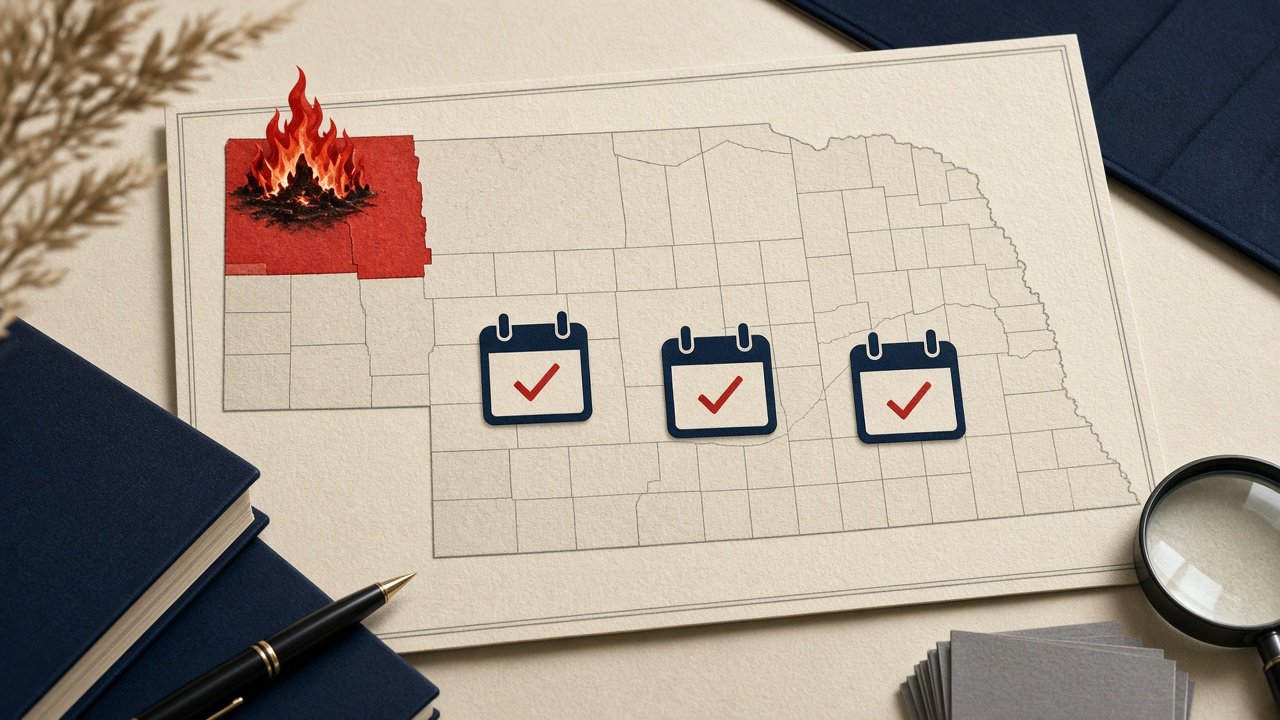

- Taxpayers in Morrill, Garden, Arthur, Keith, Grant, Lincoln, Dawson, Frontier, Saunders, and Red Willow counties (plus any added later) get an automatic extension to Feb. 1, 2027, for many filing and payment deadlines.
- The extension applies to individual and business returns, estimated tax payments, and some payroll/excise taxes originally due between March 12, 2026, and Feb. 1, 2027.
- If you live or run a business outside the listed counties but were impacted, contact the IRS at 866-562-5227 to request relief.
For background on this issue, read our Disaster tax deadlines guide and check the disaster deadline tracker.
What the IRS Announcement Means for Nebraska Taxpayers
On August 25, 2026, the Internal Revenue Service announced special tax help for people and companies hurt by the wildfires that started March 12, 2026, in parts of Nebraska. This relief postpones several important tax deadlines to February 1, 2027. The goal is to give affected families and business owners extra breathing room while they recover.
A "covered disaster area" is the official list of locations where the IRS applies this automatic help. Right now that includes Morrill, Garden, Arthur, Keith, Grant, Lincoln, Dawson, Frontier, Saunders, and Red Willow counties. The list can grow if the state adds more counties later. You can always check the current list on the IRS Tax Relief in Disaster Situations page.
Republic Tax Relief notes that while this wildfire relief focuses on postponing filing and payment dates rather than resolving existing tax debt, readers with separate IRS or state tax issues may have questions about how the extension affects their overall situation. The firm offers a free, no-obligation initial consultation to discuss suitability, scope, fees, and availability of private tax-resolution help.
Who Qualifies for This Relief
You qualify as an "affected taxpayer" if you live in one of the listed counties or if your business (including nonprofits) has its main office there. Relief also reaches people whose important tax records are kept inside the disaster area, even if they live elsewhere.
Disaster relief workers from government or recognized charitable groups helping in the area are covered. So are visitors who were killed or injured because of the fires. The IRS automatically applies the relief to qualifying taxpayers based on their address, but those outside the listed counties should call 866-562-5227 to request it.
Tax professionals who keep records for 10 or more clients affected by the disaster can follow special bulk-request guidance from the IRS.
Which Deadlines Are Postponed
Most federal tax returns and payments that were originally due on or after March 12, 2026, and before February 1, 2027, now have until February 1, 2027, to be completed. This includes individual income tax returns, business returns, partnership and S-corporation forms, estate and trust returns, and certain employment and excise tax returns.
Estimated tax payments get the same extension; you will not face penalties for underpayment as long as you pay by the new February 1, 2027 deadline. Quarterly payroll and some excise tax returns that were due on April 30, July 31, or November 2, 2026, are also covered.
A special note on deposits: penalties for payroll and excise tax deposits that were due between March 12 and March 26, 2026, will be forgiven if the deposits were made by March 27, 2026. Most information returns (such as W-2s and 1099s) are not covered by the postponement.
Additional Help and Important Reminders
The IRS will waive normal fees when affected taxpayers request copies of prior-year returns using Form 4506 or 4506-T. Simply write the disaster number SD-0010-DR in bold at the top of the form.
If you received any payments from the government or charities because of the wildfires, check IRS Publication 525 to see whether those amounts count as taxable income. A new federal law also gives extra time to claim refunds or credits when deadlines are postponed because of a disaster.
If you get a penalty notice for something that fell in the postponed period, call the number on the notice and the IRS should remove the penalty. People working with the IRS on collection or audit matters should explain how the wildfire affected them so the agency can respond appropriately.
Free Tax Help and Next Steps
The announcement reminds taxpayers that free return-preparation help is available through Volunteer Income Tax Assistance (VITA) and Tax Counseling for the Elderly (TCE) programs. You can locate the nearest site by calling 800-906-9887 or using the VITA Locator Tool on IRS.gov. Note that these sites usually cannot assist with claiming disaster-related losses.
Individuals and families with adjusted gross income of $89,000 or less can use IRS Free File guided software at no cost. Military members and some veterans may also use the MilTax program for free federal and limited state return preparation.
For the most accurate information about your situation, visit IRS.gov and search for "Nebraska wildfire relief" or the disaster number SD-0010-DR. Rules can be updated, so checking the official source is the best way to confirm your deadlines and options.
Announcement covered: Aug 25, 2026.
General information only, not individual tax, legal, or financial advice. Rules, deadlines, and eligibility depend on your circumstances. Check current official guidance or consult a qualified professional.
Request a correction →